info@kaizendentalhawaii.com

What are Snap In Implant Dentures?

Snap-In Implant Dentures are specifically designed dentures that can easily attach (snap-in) to the dental implants installed by your doctor. By anchoring your dentures with dental implants, you can benefit from:
- Enhance your enjoyment of favorite foods: By securing your denture with dental implants, you can chew with greater power and confidence.
- Experience a non-removable solution: Unlike traditional dentures, dental implants stay securely in your mouth.
- Smile and laugh without worry: Say goodbye to the fear of dentures falling out.
- Live more comfortably: With dental implants, your dentures will move less, reducing rubbing and chafing.
- Improve nutrition: Chew your food better with the help of dental implants.
- Suitable for those with limited bone: Even if you have been told you don't have enough bone for implants, this option requires the least amount of bone.
- Prevent bone loss: Dental implants stimulate the jaw, encouraging the body to continue producing bone and reducing bone loss.
- Reduce or eliminate gagging: In some cases, the removal of a portion of the palate can eliminate gagging caused by dentures.
- Increased comfort: Dental implants help reduce or eliminate the irritation caused by denture movement.
- Enhance taste sensation: Implants can allow for the removal of part of the upper denture's palate, improving your ability to taste food.
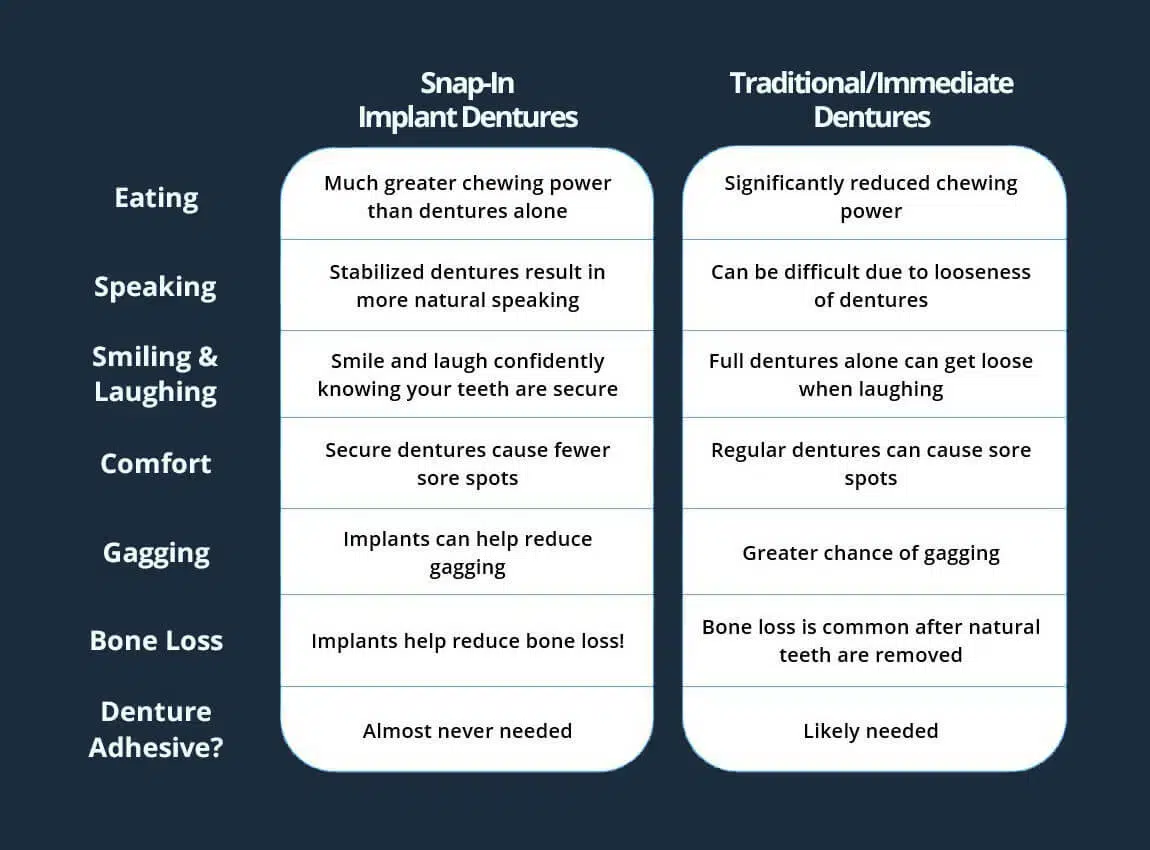
Snap-In Implant Dentures vs. Traditional Dentures
Although traditional dentures are a cost-effective solution for replacing bad or missing teeth and may appear aesthetically pleasing, they often fall short in terms of function, stability, and chewing ability.
Here are some drawbacks of traditional (non-implant) dentures:
- Limited chewing power: The lower denture tends to move, resulting in very little chewing power, typically only 10-20% of what a person had with natural teeth. The constant movements of the tongue and cheeks can make the lower denture unstable.
- Speech difficulties: The movement of the lower denture can make speaking challenging.
- Embarrassment: People with traditional dentures may feel self-conscious about eating in front of others, laughing loudly, or engaging in confident conversations due to the fear of dentures becoming loose and falling out.
- Discomfort: Traditional dentures, especially lower ones, can move around and cause irritation and discomfort by rubbing against the gums.
- Poor nutrition: The loss of chewing power can make it difficult for patients to eat a balanced diet and properly digest food.
- Bone loss: After tooth extraction, individuals typically experience significant bone loss, which continues throughout their lives. This makes wearing traditional dentures increasingly challenging over time.
- Gagging: Traditional upper dentures cover the roof of the mouth to provide suction and stability. However, this can cause some individuals to gag. Trimming the denture to reduce gagging compromises stability and natural suction.
- Snap-In Implant Dentures offer significant improvements in addressing all of these issues.
Am I a Candidate?
Almost all patients are eligible! We simply require a brief consultation to confirm. During this appointment, we will conduct a 3-dimensional scan of your jawbones, the dentist will examine your mouth, and they will thoroughly review your medical history with you.
How many implants Will I Need?
Upper | A minimum of 4 implants is necessary for an upper implant denture.
Lower | For a lower implant denture, a minimum of 2 implants is required, although using 3 or 4 implants usually results in a notable enhancement in retention and stability.
Snap-In Implant Dentures vs. Traditional Dentures
Snap In Dentures Cost
Our pricing is unmatched in the area, delivering exceptional results. This is made possible by our expert dentist, who handles the entire procedure, and our skilled in-house dental lab technician. Together, they have successfully completed this procedure countless times.
Frequently Asked Questions
Snap In Implant Dentures Procedure Timeline
The process typically takes around 6 months from start to finish.
Procedure
Once all remaining teeth are extracted and any required oral surgery is completed, the implants are inserted into the jawbone. Subsequently, the implants are usually not visible as they remain undisturbed in your jaw for a minimum of 4 months, allowing your bone to fuse with them through a process called osseointegration.
Post Op
Please schedule a post-operative appointment for the day after your procedure. During this appointment, we will assess your mouth, ensure the dentures fit comfortably, and address any inquiries you may have. We look forward to seeing you then.
Soft Liners / Soft Re-Fittings
Soft liners are used as cushions in your denture during the healing process. They serve to fill the gaps between your gums and dentures, providing cushioning for your gums. Additionally, they improve the fit and comfort of your dentures.
Uncovery
This surgical procedure involves exposing the implants and placing small healing abutments on top of them. This is done to shape your gum tissue and prepare you for the final step of fitting your snap-in dentures.
Attachment of Implants to Dentures
We will replace your healing abutments with denture abutments and complete the necessary procedures to connect your dentures to your implants. Typically, this process can be completed within a day, although occasionally it may take a bit longer.